

Anglicanism
When Canterbury fails
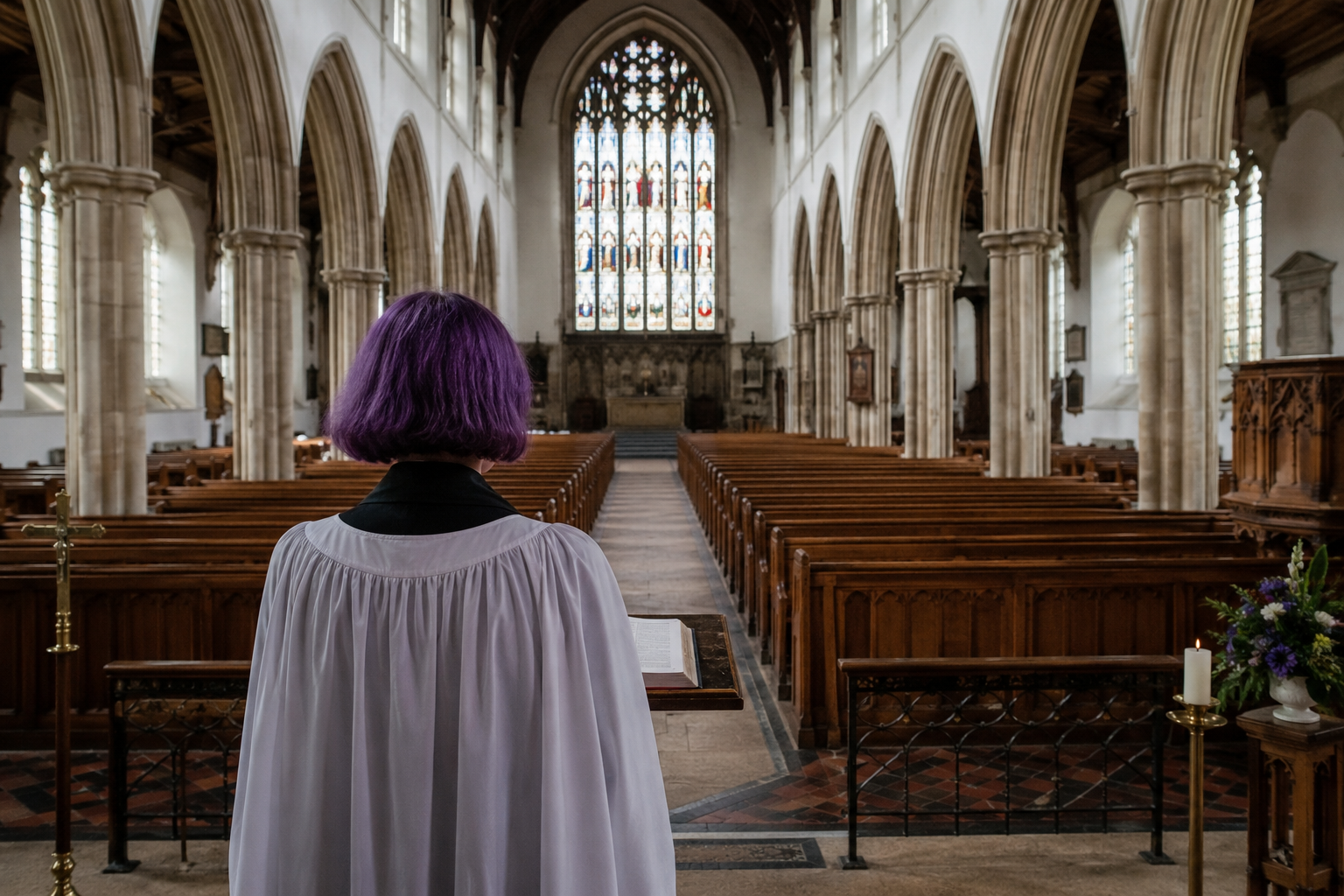
Discos in cathedrals and confusion on doctrine have left Anglicanism wanting at a time when many are searching for a counter-cultural truth. But how should a Catholic convert respond to leaving behind the Church of England? And what good can still be carried across the Tiber? I once read that converts from one church to another have a sort of grace period after which criticism of their former denomination becomes mere malice. Having just become a “stinking papist” (to quote Diana Gabaldon’s Outlander ), I thought I might take advantage of this special dispensation. For although I became Catholic for positive reasons, certainly my old Anglican tribe was generous in its provision of negatives. It would be remiss of me, however, to skate over the good. So let me say that when it comes to beauty I have yet to encounter a psalter quite as gorgeous as Coverdale’s. Regarding “our own hateful Cranmer” (as a Servite priest I know once homilised), the 1662 Prayer Book – containing as it does the Anglican Church’s entire liturgy, from baptism to burial of the dead – is a masterclass in convenience. The Prayer Book was my first introduction to the Divine Office, and I was lucky to have had a pastor open to using it. Indeed, soon after my reception into the Anglican Communion, I was given the honour of leading Morning Prayer on Thursdays. I joined the PCC. I began to deacon. I even began seriously to consider the priesthood. I was also part of a Bible study group, for lack of a better term, which we cheekily called The Corinthians. It was in the Corinthians WhatsApp group that things began to unravel. Prompted by a question from one of the members – I’ll call him Bob – the vicar invited us each to submit our definition of Anglicanism. It is difficult to know quite how to describe the resultant confusion without quoting from the exchange. Bob: What’s the Anglican take on the Eucharist? Closer to Catholic or Reformed? Vicar: Unfortunately that can’t be answered. Bob: So in effect it’s left to each person’s interpretation? Vicar: Not exactly. There are people who receive for years without becoming Anglican. Bob: Well tonight has thrown me a bit. I was absolutely convinced the C of E was Protestant. Vicar: Well, it’s good to be thrown. An expression that Anglican theologians have used over the centuries is the via media. We see ourselves as reconcilers, though that also needs unpacking. Bob: On a side note, I thought I’d share something I found amusing yesterday. There’s a church in Mexico that uses crisps and Coke in the Eucharist. Lol. Lol indeed. I like to think this exchange stands alone as a decisive rebuttal of the entire Reformation project. One would have thought, I mean, that the certainty of Cranmer and his heirs – the sheer resolve with which they hunted priests, sacked abbeys, debased the Virgin Mary and reimagined the liturgy – might have corresponded to an equally certain theology of the sacrament of the Eucharist. Not so. What, then, was it all for? The ability to claim, some four hundred years later, to be a “reconciler”? Reconciled to what, exactly? Error? One is reminded of Newman: “Between two extremes, there is no middle way; between truth and error, there is no neutral ground.” The exchange disturbed me tremendously. For though I had prepared my own answer – itself, in retrospect, confused – I had seen that even the beloved fallback of lex orandi, lex credendi could have no purchase in a communion in which some ministers (I had met them) were unwilling to touch the BCP – their own official liturgy – for being too Catholic. For my fiancée and me, there was to be one other event that drove the nail clean into the Anglican coffin. It was summer. The Corinthians had gathered in one of our gardens to discuss Taizé, the ecumenical youth community based in the French village of the same name. A chance comment led to a discussion of whether we ought really to be hosting discos in our historic cathedrals. That is, should we really be exposing the tomb of St Thomas Becket to spillages of vodka and Coke from jiving millennials who at any rate regard the Church of England as the Jesus contingent of the DEI agenda? The answer, obviously, is no. But it fell to the Corinthians’ three youngest members – the very people whom the C of E’s boomer leadership are most desirous to “attract” – to point this out. Our two pastors, on the other hand, exhibited not the slightest whiff of indignation. Specifically, one was indifferent and the other wholeheartedly in favour. The shepherds had abandoned their flock, or at least that portion of their flock who wished to respect tradition. In my experience, Church of England clergy remain dogmatically obsessed with the nostrums of the 1960s and ’70s. They fail to reckon with the urgent spiritual needs of the 2020s. “Women”, “the gays”, “eco churches” are forefront in their minds – the salvation of souls, not so much. (And why would they be? Most are universalists.) Female bishops are the best thing since Evensong. Sex – the very word – is titillating, as though the ravages of the sexual revolution had never manifested themselves. But is the host transformed into the body, blood, soul and divinity of Our Lord Jesus Christ? “Unfortunately that can’t be answered.” And even if it could, “it’s good to be thrown” – a statement flatly incompatible, one would have thought, with the very possibility of sound catechesis. It took me a long time to realise that, in the end, Anglicanism – which began with the cynical power, land and money grab of a schismatic king – exists and has ever existed to keep the faithful from the Blessed Sacrament in the Holy Sacrifice of the Mass. It may on occasion wear the garb of Catholics in the buildings it stole from Catholics. But, like drag queens, all it can do is insult the object of its pantomime. After announcing my intention to swim the Tiber, my old pastor was keen to present me with a list of what he regarded as the Catholic Church’s sins against liberalism, including its stances on abortion and sexual ethics generally. It was supposed to put me off. He couldn’t understand that they were part of the attraction. I am twenty-nine. Many in my generation have wised up to the fact that we have inherited a civilisation at the nadir of its spiritual, intellectual and artistic life. Modernism, that heresy of heresies – comprising as it does liberalism, rationalism, naturalism, secularism, etc – holds sway. Whole books are written about the consequences of these forces, although a brief shopping list would include the trans phenomenon; the ever-expanding “empire of rights” (to travel, to contracept, to abort and soon perhaps to death itself); and the deification of the political process. There is also the growth of New Age spirituality: for our malaise is spiritual, not political, and one might say that the extent to which cultural commentators grasp this – one thinks of Paul Kingsnorth – is the extent to which they are worth reading. Our Lord says: “If you belonged to the world, the world would love you as its own. Because you do not belong to the world, but I have chosen you out of the world – therefore the world hates you.” The Church of England has fallen in love with the idea that it might remain relevant by meeting the world on its own terms. It has lost the ability to exhort us to holiness; it has honed the ability to mock the very notion. It will not condemn degeneracy; it will move heaven and earth to justify it. It cannot preach repentance; it can minimise the need. It’s not that the Catholic Church is immune to the same progressive disease. But she has strong antibodies. She has the Catechism. She has Our Lord’s promise in Matthew 16:18. Whatever the views of Catholic parishioners, one may be sure that every particle of the Eucharist is transformed into the body, blood, soul and divinity of Christ. It is refreshing to expect the “Hail Mary” by default and not because the minister woke up feeling sufficiently orthodox. From a theological point of view, then, I will be glad to see the back of a communion predicated upon the rejection of the Catholic Church. From a social and cultural point of view, I am not so sanguine. For though they lack the Mass, Anglicans do at least use their churches for quintessentially social and religious purposes that, in spite of the Reformation’s initial violent rupture, have after hundreds of years found a settled – and settling – place in the spiritual and artistic life of the nation. In the years to come, more and more of these beautiful buildings will have to close down, a process already well under way and not at all helped by Welby’s recent war on the parish system. Unless the Catholic Church is willing to reclaim them, they will be converted into flats, clubs or mosques. The loss would be incalculable. Could this process have been arrested by an invigorated Prayer Book Anglicanism that held Jewel and Andrewes dearer than Welby and Cottrell? Who knows. The analogue would be the various Catholic Latin Mass societies, which flourish in spite of – and perhaps because of – what can only be described as persecution from above. Cranmer’s Prayer Book may be lacking from a Catholic point of view. But I have seen firsthand its power to attract the young. Many Anglican ministers hate it, not so much for its theology, but because it leaves so little room for them to impose their personalities. There is no rubric that reads: here the minister may play guitar, or: here the minister may employ the gimmick of pacing the nave during his sermon. British Christianity needs oxygen. When it finds it, it will, I suspect, be inhaled by the two great apostolic lungs of Catholicism and Eastern Orthodoxy. The recent news that Catholics may soon outnumber Anglicans, and already do in the younger age brackets, in England is a symptom of a larger cultural and spiritual renaissance. Thirsty people go to where the water is. And Canterbury is all dried up.
May. 25, 2026