A Brazilian bishop has said that young Catholics drawn to more traditional forms of worship have a legitimate place in the Church, insisting that such expressions are part of the inherent diversity of Catholic life rather than a rupture within it.
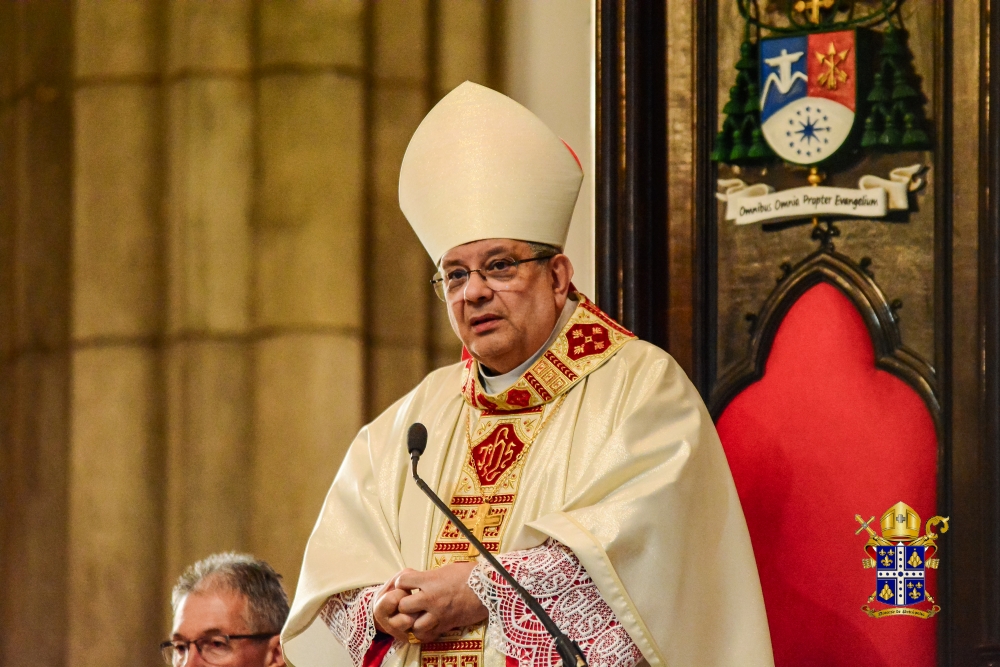
Speaking at a press conference during the 62nd General Assembly of the National Conference of Bishops of Brazil in Aparecida, São Paulo, Bishop Joel Portella Amado of Petrópolis addressed questions about the resurgence of interest among younger Catholics in older liturgical customs.
The liturgy must not become a source of conflict and division among us.
Responding to a question from a journalist with Rede Vida TV about “a return of a certain Catholic traditionalism in Masses”, the bishop acknowledged visible signs of this trend, including “young people who kneel to receive communion, who wear veils”, adding that “it is possible to perceive this in the Masses”.
He said that such developments should be understood within the broader context of contemporary religious life in Brazil, particularly among younger generations. Referring to census data from 2022, he noted the large number of 19-39 year olds who do not profess a religious belief. “It’s not that they don’t believe in God,” he said. “The evangelical side calls them ‘unchurched’. I prefer this expression. They believe in God in heaven, but they don’t have a mediation on earth, a path to the Church.”
Within this context, Bishop Amado indicated that the attraction to more traditional forms of worship may arise from a wider search for meaning. “In times of emptiness, we start searching, we look for things, even in some historical realities that this youth did not experience,” he said.
Bishop Amado, who serves as president of the CNBB’s Commission for the Doctrine of the Faith, emphasised that diversity in liturgical expression is not only permissible but intrinsic to Catholicism itself. “Does it have the right to be this way? Yes, because Catholicism is plural by nature, even more so in a profoundly plural world,” he said.
At the same time, he cautioned against any tendency to elevate one form of expression above others or to impose personal preferences on the wider Church. “While there is a right to live and express one’s faith in one’s own way, according to one’s own personality, on the other hand, in the name of love and brotherhood, one cannot impose this on others or believe that only one is right,” he said.
The bishop’s comments come amid an ongoing conversation within the global Church about the place of traditional practices in contemporary Catholic life, particularly in the years following the liturgical reforms of the twentieth century and subsequent debates over their implementation.
While the early signs of Pope Leo XIV’s approach to the TLM suggest not a dramatic reversal of his predecessor’s policy, they do point to a deliberate attempt to reframe the question in terms of unity, discipline and synodality. What is emerging is a repositioning of the issue within a broader vision aimed at removing ideological conflict and quietly adjusting the tone.
Further clarity has come through the remarks of Cardinal Pietro Parolin after he sent a letter to the French bishops on behalf of Pope Leo concerning the TLM. Speaking to Advaticanum’s Vatican correspondent the following day, Cardinal Parolin articulated what appears to be the governing principle behind the Pope’s thinking. “I think we all share this, this, let’s say, assessment that the Pope gives, right?” he said. “In the sense that the liturgy must not become a source of conflict and division among us. It will be necessary to find the formula that can meet legitimate needs. But I believe that this can happen without turning the liturgy into a battlefield.”
Sources have told Advaticanum that many cardinals and bishops expect a forthcoming document on the liturgy, following an anticipated encyclical on artificial intelligence. According to these curial sources, the document is likely to address reverence and ritual integrity in the ordinary form of the Roman Rite, as well as the complex issue of inculturation. Such a move would confirm that the Pope’s concern is with the quality and unity of Catholic worship as a whole.